Wednesday, 6 November 2013

PEDIATRICS ROTATION


PEDIATRICS

ROTATION #3 - PEDIATRICS OUT PATIENT


Pediatric out patient was very fun. It was different in that you circulate throughout different areas to get a true experience of the different services offered for children’s health. Here are the places I got to go to.


1. Pediatric Emergency – MTA (Minor treatment area)

This was similar to emergency. As with all emergency rooms patients are triaged based on severity. As the name suggests MTA implies non life threatening concerns. I saw

Children with Fever – Usually means the child has a cold and the parents are concerned. First we rule out infections first such as ear, throat and urinary tract infections. Then we provide reassurance that there is no “bad” underlying cause. 
Rash – The story I came across the most was the patient had a fever then broke out into a rash. With children rashes are common in viral infections again reassurance is key.
Cough – This again goes with the rash and fever. Most children develop a post-viral cough which could persists for up to weeks after being sick.
Broken bones – I was told by one of the docs that it is common to see broken bones in children but the key is to make sure not to expose the child with too many x-rays. Here I saw fractures on fingers, radial and ulnar fractures as well as displacements.
Concussion
Herpes gingivostomatitis
Ear infection
Strep throat


2. Pediatric Physiotherapist (PT) and Occupational therapist (OT)
Was able to observe what PTs and OTs do with children with developmental delays

3. Pediatric Speech Language Therapist
Learned the approach of a speech language therapist for children. I also learned that parents are a big influence in inducing positive changes.

4. Fetal Alcohol Spectrum Disorder Clinic
I was able to observe how a child is screened for a possible fetal alcohol spectrum disorder

5. Shadowed a Pediatric Nurse Practitioner
Here I was able to do some well child/baby exams as well as see some concerns such as cough and fever.


ROTATION #4 - PEDIATRIC IN PATIENT

Felt like that cat in this rotation :P
This rotation is definitely the most different from the ones I had previously. In pediatric in patient you work with children who have been admitted to hospital. This is a typical day


7:00 am – Meeting with the team and sign over from overnight. You are assigned your patients that you are responsible for the day. This can be between 3 - 6 depending how many people you have on your team that day. 

7:30 ~ 9:00am – You pre round on your assigned patients. This includes asking the parents how their child did overnight, any concerns ie. If they are admitted for diarrhea ask if there were any episodes. If they are admitted due to asthma exacerbation ask if the patient required any puffers overnight. This also includes a focused physical exam. What is also important is determining urine output and ins/outs. This ensures the child is well hydrated.

To calculate urine output 

Urine output = Total urine volume (mL) / Time (hr) / Weight (kg)

Ex. A kid had a urine volume of 500mL in 8 hr and weighs 32kg
 Urine output would be 1.95 cc/hr/kg


For infants urine output should be >1cc/hr/kg for children >0.5cc/hr/kg. If less this is oliguria and may suggest dehydration or renal problems

9:00 -12:00 – Rounds
The team including yourself, other students the sr. resident and attending discusses and sees each patient on the service. For your patients you introduce them ie. 5 y/o F admitted for diarrhea. Then you talk through the problem list and the plan for each problem. You might also call other services for consults such as pediatric cardiology and pediatric gastroenterology

Afternoon - The afternoons can be very busy. You are responsible for calling the services that you’ve consulted for your patient and determining if they have seen them and what they recommend. This can mean going to their chart to see if the other services have written suggestions as well as checking if any results has come back from any tests that were sent. You are also responsible to write SOAP notes on each of your patients.

S = subjective – This is what the parents told you about how the night went or if the child said they felt pain or felt better.
O = objective – this includes vitals and lab results as well as what you found on your physical exam
A/P = assessment/ plan – This is where you write your problem list and your plan. Always include nutrition/hydration and discharge planning (Disposition) Example.
1.       Diarrhea – monitor, pending labs for GI, abdominal x-ray scheduled tomorrow
2.       N/H (nutrition/hydration) – standard pediatric diet, monitor ins/outs, daily weights
3.       Disposition – when diarrhea has resolved and cause has been determined.

 4:00 pm – sign over to the person on call.

ADMISSION NOTES


Another crucial thing that you learn is how to do a thorough admission note. This includes.

1. Date/Time
2. ID & Chief complaint
3. History of present illness
                - includes hydration status # diapers #stool, fluid intake
                - Emergency room – management
4. Past Medical History
                - including past hospitalizations
5. Birth History
6. Medications/Allergies
7. Immunization status
8. Development – milestones (Gross, fine motor and social, language)
9. Diet
10. Family Hx
11. Social Hx
12. Adolescent – HEADDSS (home, education, alcohol, drugs, diet, sex, suicide, depression)
13. Review of systems
14. Physical Exam
15. Labs & Imaging
16. Impression
17. Problem List/ Plan

This would take me 2.5 – 3 hours. Take time to read through the entire chart and understand what the issues are. The internet will be handy for this.


SUMMARY OF THE THINGS I DID/SAW


- How to present cases
- Admissions
- Fever in newborn – full septic workup in children from newborn to around 2 months
- Croup
- Bacterial tracheitis
- Pneumonia
- Asthma exacerbation
- Diarrhea
- Constipation – fecal impaction
- Failure to thrive
- Feeding intolerance
- ALTE – acute life threatening episodes – usually a parent saw their child go limp or saw perioral cyanosis but the episode resolves after the parent picks the child up
- Brain lesions
- Anorexia Nervosa
- Seizure
- Social issues – parenting/abuse
- Eczema
- Perinatal infections – TORCH (Toxoplasmosis, Other (syphilis, varicella-zoster, parvovirus B19), Rubella, Cytomegalovirus (CMV), and Herpes infections)
- UTI
- Heart murmurs

This rotation for me was eye opening and overwhelming. Working on the wards you get to see the relationships of the different professions ie. Nurses, residents, students and different services. With pediatrics inpatient you need to spend time studying around your cases. The best way to think about it is to think of what would do if you were the sole care provider of the patients that were assigned to you. You should be spending time looking into their problems and developing a plan. That way during rounds you have a plan ready to present to your sr. resident and attending.

Overall I’ve learned a lot in the pediatric rotation as a whole. This was by far the toughest rotation yet. :S 

How I looked during and a few days after pediatrics inpatient :P

Monday, 4 November 2013

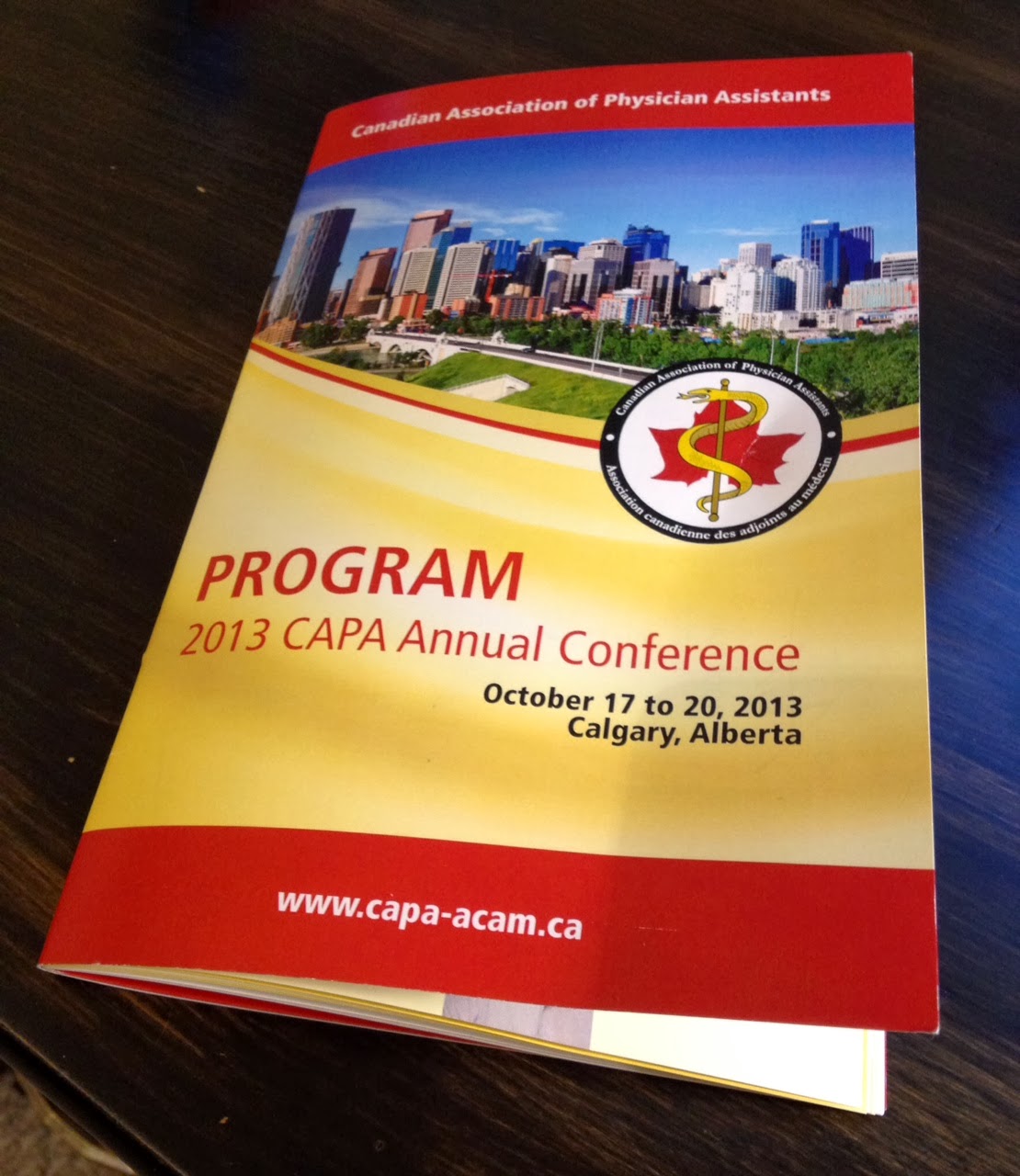
CAPA 2013 CONFERENCE - Calgary


Hello all. It has been awhile since my last post and I have a lot to write about so expect a few more posts this week

For now I wanted to talk about my time at the CAPA conference in Calgary. Overall it is was a blast. Networking opportunities were great. Here was the breakdown of what I did that weekend.


 FRI OCT. 18
The hallway leading to the conference rooms

The morning started out with breakfast then the address of The keynote speaker, the Alberta Minister of Health, The Honourable Fred Horne. He gave the great news of Alberta being in full support of Physician Assistants as well as job openings for PAs in the province. For more information click the link below.


After the keynotes address I had to choose between two different sessions at one time to listen in on. Here are the sessions I went to.


1. Building the bridge to collaborative practice by Deb Gordon, RN, BScN, MBA, CHE

2. Procedural Sedation in the ED by Brent Crawford, CD, MD, CCFP(EM), FCFP

3. Developing cultural awareness and safety in clinical practice environments and the class by Ian Jones, MPAS, PA-C, CCPA 

That evening there was a president’s reception which give more opportunity to network. It was great to feel part of a group and see more than a handful of PAs in one room.
 
PAs working in Manitoba - not including me still a student :)

SAT. OCT 18

The day started off with a student breakfast session about launching your career. There weren’t any students that came from University of Toronto that I remember (correct me if I'm wrong). There were 2 students from McMaster and Ryan and myself from U of M. There were a good handful of graduates from different programs with a good representation of U of M grads. This gave opportunity to ask how their experience has been and how their working experience has been since graduating. As for the session the most important piece of information I gathered was when looking for employment it is best to have a clear understanding of your role and how you will be trained as a newly graduated PA. This way you understand what level the doctor expects you to be at in a certain amount of time. Communication with your supervising doctor(s) is the key.
 
Ryan and I representing U of M

After the student session/breakfast. The keynote speaker was Sunil Sookram, MD, FRCPC who talked about STEMI Care

Afterwards I went to the following sessions

1. Occupational medicine PAS “The Ekati experience” by Jack Buchanan MPAS, CCPA

2. Otolaryngology: 10 min with a patient with an ear complaint by Allan Ho, MD

3. Emergency medicine: top 25 diagnosis compared to the curriculum map. Are we teaching the right stuff? By Dianna Wachtel, MS, PA-C, CCPA

4.  Dentistry for primary care by Tim Barter, DDS

5.  Damage control resuscitation (DCR): Advances and controversies by Andrew Kirkpatrick, CD, MD, FACs, FRCSC, MHSC

Looking back at the sessions I admit some of the material went over my head but it was amazing how much you understand after being in PA school for one year.

There was also opportunity to see the progress of each regional chapter. Currently there are 4 chapters Prairie, Atlantic, Quebec and Ontario.  I sat in the Prairie chapter forum. Issues that are discussed include any changes in legislation, any issues PAs face and job opportunities in the respectable provinces.


SUN. OCT 20

The morning was opened up by awards then followed by the keynote presentation entitled The Alberta PA project given by Neil Gibson, MSc, MD, FAEP, FRCPC

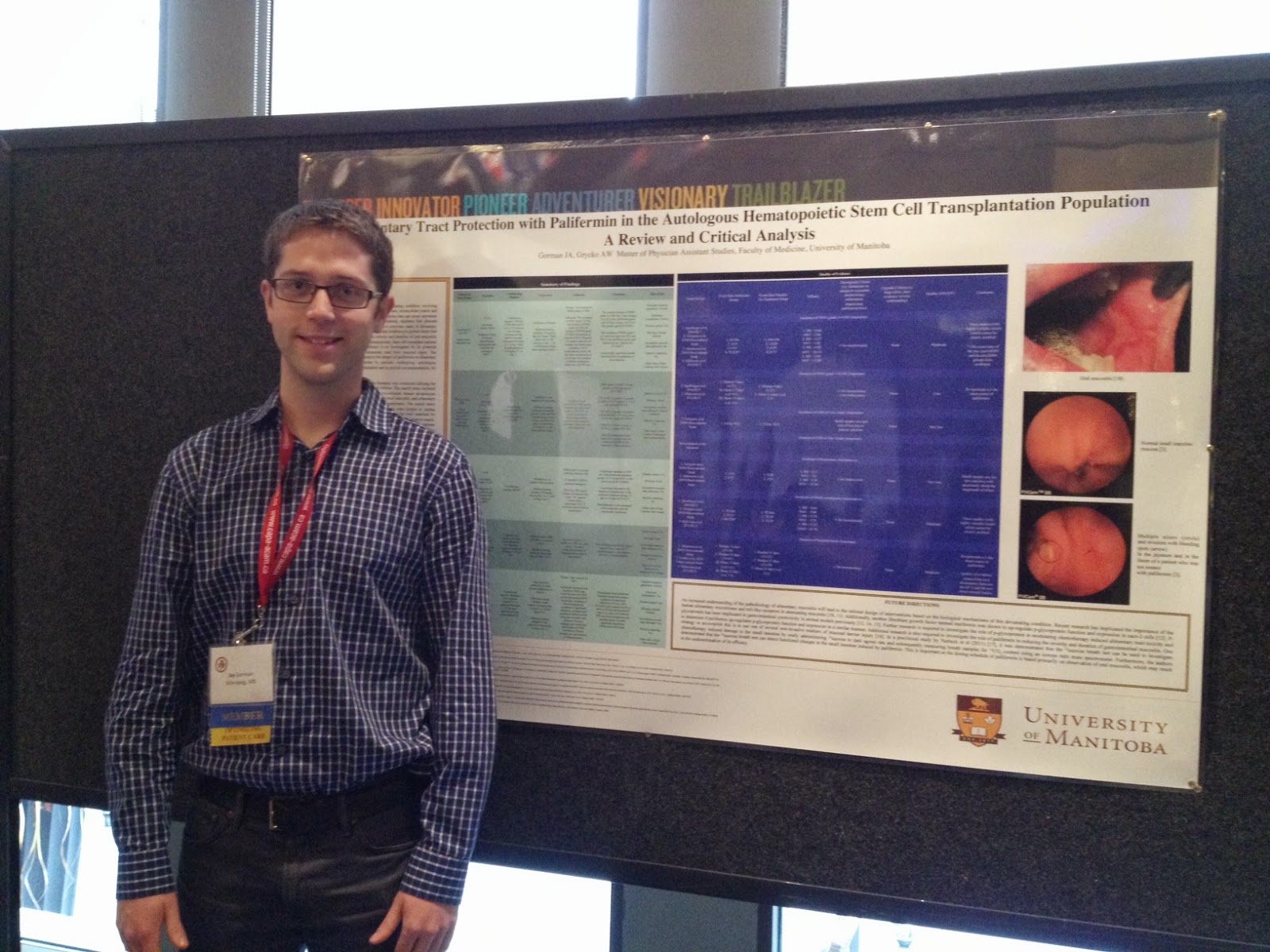
Jay, U of M 2013 grad, won a CAPA award for his poster - congrats!

Ended off the conference with two more sessions

1. Back pain in children and adolescents by Philip De Muelenaere, MBChB, MMED, FCS 

2.  Management of airway emergencies - priorities preparation and passing the tube by Kate Doyle MD, FRCPC


I highly encourage any student who is reading this to take the opportunity to go to the next CAPA conference in Halifax in Oct 2014. Being with a group where everyone knows your role is encouraging and strengthening. Seeing the development of the profession is exciting and makes you feel part of something bigger than just being a Physician Assistant student. Going to the CAPA conference gives you a group you can belong to. :)


Candid photos of past U of M graduates taking pictures by their poster


Sunday, 6 October 2013

ROTATION #2 - ORTHOPEDICS


ORTHOPEDICS
 Another rotation has ended. This one was a tiring rotation. It consisted of long hours and overnight call shifts.  

My drawing interpretation of the team. Me with a few tall dudes :)
TYPICAL DAY IN ORTHO

6:45 am – The ortho team meets up and discuss any new consults that had come overnight or any issues with current patients on the ward

7:00am – We start morning rounds

9:00am - The rest of the day is filled with either outpatient clinics or consults from emerge or in hospital wards.

For every consult and patient we saw in clinic we always checked if the patient was neurovascularly intact in the area that they had surgery or injury to. Here are the nerves that we tested

UPPER EXTERMITY (HAND)
NERVE
SENSORY
MOTOR
Radial
1st dorsal webspace
Wrist extension
Medial
Index finger
Thumb Abduction
Ulnar
Lateral of 5th finger
Finger Abduction
AIN (branch of median)
N/A
A okay sign
PIN (branch of radial)
N/A
Thumbs up

LOWER EXTERMITY (FOOT)
NERVE
SENSORY
MOTOR
Deep peroneal
1st dorsal webspace
Dorsiflexion
Superficial peroneal
Dorsal foot
Eversion
Tibial
Plantar surface
Plantar flexion
Sural
Lateral malleolus
N/A
Saphenous
Medial malleolus
N/A

 4:30pm – sign over to the overnight on-call ortho team.

ORTHO SURGERY

Similar x-rays I would see on outpatient clinics
I did have a chance to scrub into a few surgeries. Of course it was embarrassing not knowing all the rules in the OR but I was able to do some cauterization, suction and cutting sutures to help the surgeon. There was also a lot of holding limbs to get a proper angle to drill or screw. I do like the OR but I realized that I’m not a big fan of drills, hammers or screws. I guess that makes sense since I don’t like doing any of that at home :P


FIRST OVERNIGHT CALL SHIFT

my call room :S - took some time to get used to
After the day shift you stay the night at the hospital. As an intern you have a resident with you so you are not alone. 

4:30 to 11:30 pm – Sitting and waiting not knowing what I should do, if I should eat or go to the washroom. :P
12:00 am – got a consult
1:00am – found the on call room a dark gloomy room with a bed and no windows
3:00am – couldn’t sleep because I was freezing in bed
3:15am – got a call for a consult in emerge
4:30am – back to the on call room to get a nap in
6:00am – started morning rounds

9:30am – At home exhausted. Slept until 5:00pm

SUMMARY OF THE THINGS I DID/SAW

How to manage open fractures
Tibia/fibula fracture
Radial dislocations/fractures
Pelvic fractures
Reductions with hematoma blocks
Reductions with conscious sedation
Aspiration of a joint – I was able to do an aspiration on the wrist
Removal of a cast
Assisted in application of back slabs and casts
Post-operative follow ups
Removed staples / stitches
Wound care/management
Reading X-rays
Removal of a drain – hemivac

Overall Orthopedics was a fun rotation. I learned a lot on how the hospital as a whole functions and the basic concepts of orthopedics.